
Asian Surveying & Mapping
Breaking News
Genesys International bags ₹283 crore World Bank-funded contract for Ahmedabad digital twin
The project will map 625 sq km, survey 25...
China launches new remote sensing satellite group
TAIYUAN, Sept. 24 (Xinhua) -- China launched a new...
Ahmad Belhoul Al Falasi to lead UAE delegation at IAC 2026
UAE delegation will bring together government entities, research institutions...
Korea Signs Space Cooperation MOU With Mexico
A path is opening for domestic space companies to...
China’s space diplomacy lifts Pakistani astronaut toward orbit
KARACHI, Sept 28 (Reuters) - Two Pakistani pilots are...
NV5 Global stock expands geospatial reach with $303 million deal
NV5 Global stock is linked to a Quantum Spatial...
EU and Korea deepen cooperation on secure satellite connectivity
Today, the European Commission and the Republic of Korea...
Ghana, Japan explore deeper cooperation in space technology
Ghana and Japan are exploring deeper cooperation in space...
China conducts four launches inside 48 hours as launch options diversify
HELSINKI — China carried out four launches in quick...
Dubai Municipality deploys smart robot for geospatial surveys
Dubai: Dubai Municipality has deployed a smart robot to...

October 22nd, 2010
Central Southern China Power – 2D to 3D Design

substation_thumb


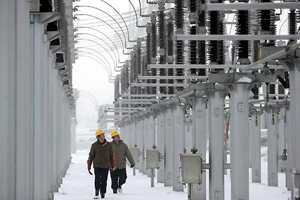
The Power Grid Branch of the Central Southern China Power Institute (CSEPDI) began using Bentley Substation Solution, a new product that enables 3D design for electrical substations. The institute operates substations in the +/- 300kV to +/- 800 kV range which are the largest investments in the organization.

CSEPDI has designed substations at Jiangxia, Yulong and Qingdao using the new approach with the goal of reducing the size of the areas needed. Often larger areas are needed in the planning stages because of the inherit 3D needs in the process. Until now this has been conducted using 2D methods, necessitating the larger area to ensure the 3D aspects could be accomodated.

Using Bentley Substation Solutions, a 3D collaborative process was initiated that enabled designers and structural participants to work together. 3D reduces unnecessary design and helps to reveal clashes between infrastructure components quickly.

Reducing margins of clearance to standard sizes and aspects also increases design efficiency. The optimized switchyard has achieved between 1.7 and 2.1% reductions in physical land requirements and have also reduced the design time by about 20%.

These substations have provided CSEPDI with greater efficiency for large infrastructure that takes about 9 months from time of conception to completion.