
Asian Surveying & Mapping
Breaking News
Palakkad Celebrates as NASA Astronaut Anil Menon Set for First Space Mission
Thiruvananthapuram, July 13, 2026: Kerala’s Palakkad district is set to...
G20 satellite is expected to be launched in 2027: ISRO Chairman
ISRO Chairman V. Narayanan has said that the G20...
Unidentified metal spheres found on Australian beach are ‘debris from a foreign rocket body’, space agency says
The Australian Space Agency says the objects "appear to...
Singapore and Japan sign agreement to strengthen space collaboration
SINGAPORE: The space agencies of Singapore and Japan signed...
Japan space probe skims asteroid in test for planetary defense
A Japanese space probe performed a flyby of a...
Hong Kong-developed ‘Eye for Space’ now operating aboard Tiangong space station
Hong Kong’s first home-grown astronaut, Lai Ka-ying, assembled and...
ISRO conducts first SOLVE ground test important for Gaganyaan missions
Sub-Orbital Launch Vehicle for Experiments (SOLVE) solid motor was...
New 3D Detection Method for Detecting Atmospheric Rivers in Antarctica
Researchers in Japan demonstrate how vertically layered atmospheric rivers...
Uttar Pradesh Govt launches Special Land Measurement Campaign
The Uttar Pradesh government yesterday launched the statewide Digi...
Japan Eyes Sovereign D2D Satellite Network
Japan plans to select a proposal this month for...
  • Oct 11, 2024
  • Comments Off on High-Tech Solutions Help Prevent Ship Groundings in Coastal Waters 
  • Feature
  • 904 Views

October 11th, 2024
High-Tech Solutions Help Prevent Ship Groundings in Coastal Waters 

Multiple recent incidents in which naval and commercial vessels ran aground have highlighted the dangers of maritime operations in shallow or poorly charted coastal waters.  

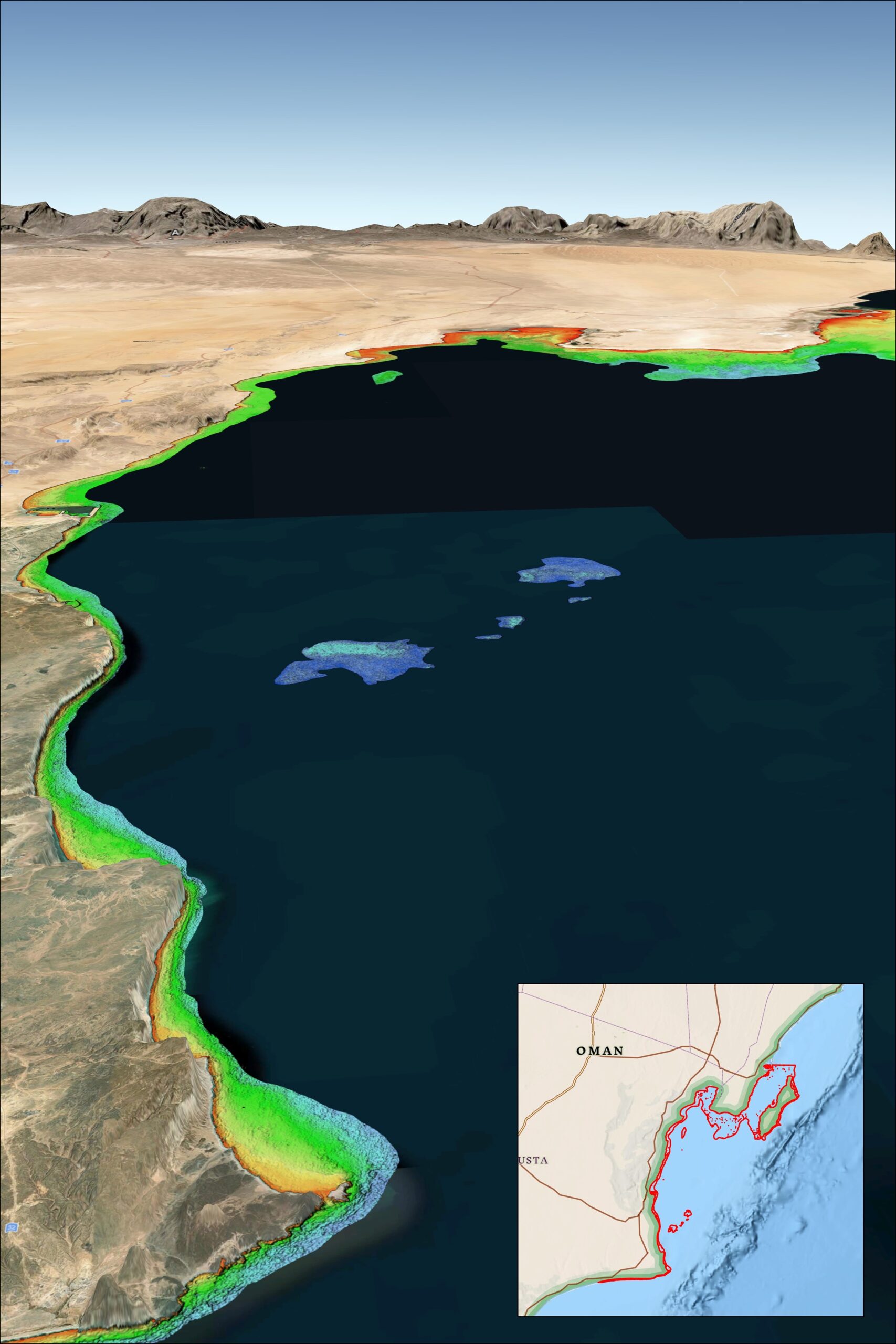
For more than 10 years, TCarta has been supplying marine charting organizations with water depth data using a technique called Satellite Derived Bathymetry (SDB). SDB applies physics-based computer algorithms to optical imagery captured by commercial remote sensing satellites. This analysis detects and measures light reflecting off the seafloor to calculate water depth. Depending on water clarity, SDB is routinely accurate to depths of 20 to 30 meters. 

The off-the-shelf bathymetry product Global Satellite Derived Bathymetry (G-SDB) offers 10-meter detail and is ideal for identifying coastal shoals in remote areas that don’t appear on nautical charts. Large-area contiguous G-SDB products are immediately available for more than a dozen critical locations, including: 

  • South China Sea 
  • Arabian/Persian Gulf 
  • Gulf of Oman 
  • Red Sea 
  • Black Sea 
  • Eastern Mediterranean  

In the accompanying image,  TCarta SDB data on the Oman Coast indicate shallow water depths by color. Red represents 0-3 meters, yellow is 3-6 meters, green is 6-10 meters, turquoise is 10-14 meters, and blue is 14-18 meters deep. Inset map indicates geographic location of dataset. [Credit: TCarta Marine]