
Asian Surveying & Mapping
Breaking News
OMEGA and MBRSC launch exhibition celebrating UAE’s space milestones and Moon landing anniversary
OMEGA has partnered with the Mohammed Bin Rashid Space...
SpaceX crash site on moon revealed by South Korean orbiter
An out-of-control SpaceX rocket that crashed into the moon...
ispace Receives Grant for Japan’s Space Strategy Fund Project “High-Precision Landing Technology in the Lunar Poles Region”
TOKYO—August 7, 2026—ispace, inc. (ispace) (TOKYO: 9348), a global...
Embry‑Riddle Asia Launches Professional Space Operations Course in Singapore Amid Regional Space Boom
As Singapore works to develop its involvement in the...
ISRO to map landslides in J&K using satellite to generate alerts
According to the government, geospatial technologies are being used...
Korea to Build 3D ‘New National Map’ Under Spatial Data Strategy
The Korean government will shift its spatial information system,...
Uzbekistan-China Satellite Project Advances with AI Module
Uzbek engineers are developing an onboard artificial intelligence module...
Thailand sees no impact from Cambodia’s plan for UN map recognition
Thailand's Foreign Minister stated that Cambodia's plan to seek...
Japan repeats Dokdo claim while calling South Korea a partner
Tokyo's 2026 defense white paper highlights territorial tensions alongside...
China unveils comprehensive geological map of Moon
China has completed a 1:5,000,000-scale geological map of the...
  • Oct 11, 2024
  • Comments Off on High-Tech Solutions Help Prevent Ship Groundings in Coastal Waters 
  • Feature
  • 923 Views

October 11th, 2024
High-Tech Solutions Help Prevent Ship Groundings in Coastal Waters 

Multiple recent incidents in which naval and commercial vessels ran aground have highlighted the dangers of maritime operations in shallow or poorly charted coastal waters.  

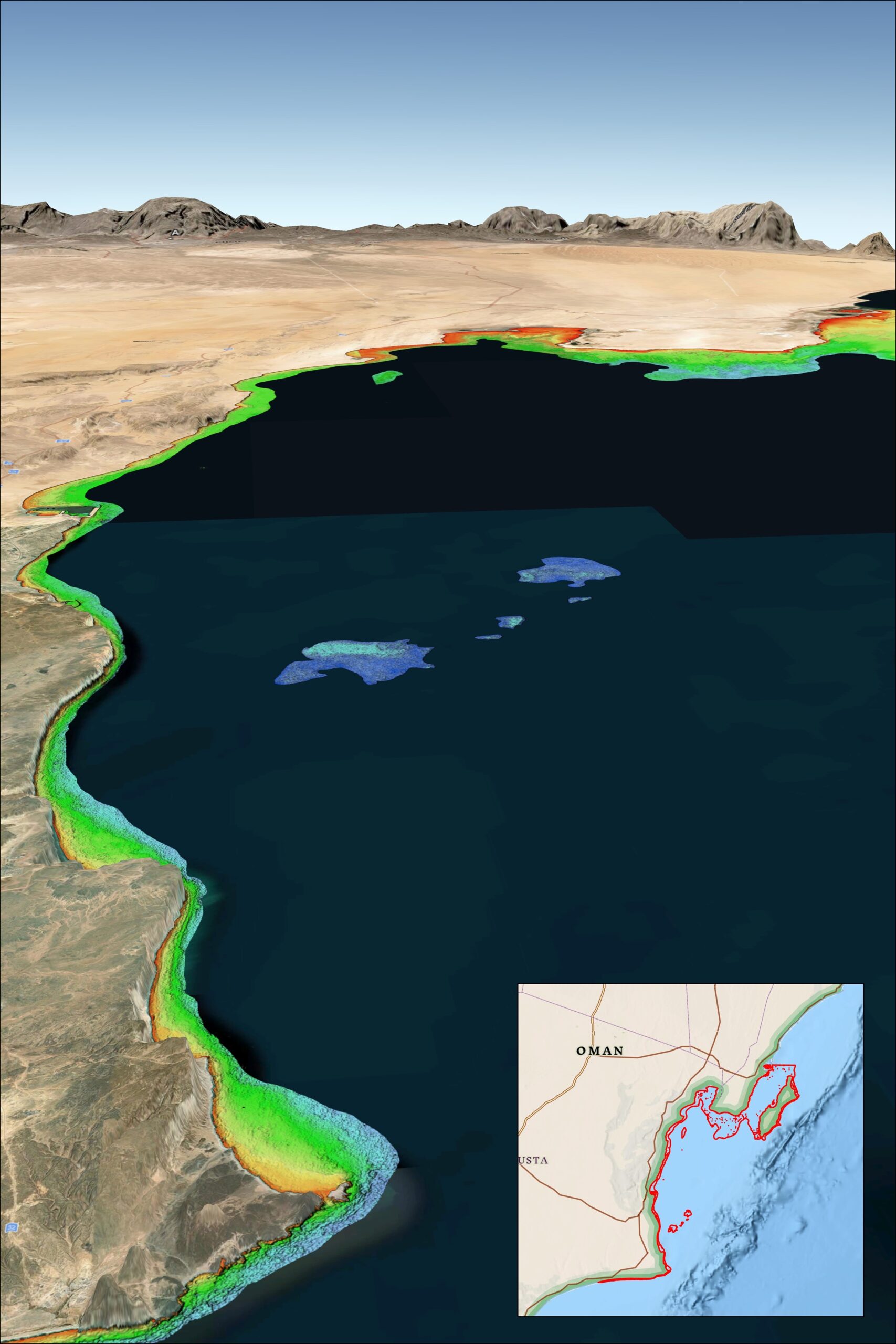
For more than 10 years, TCarta has been supplying marine charting organizations with water depth data using a technique called Satellite Derived Bathymetry (SDB). SDB applies physics-based computer algorithms to optical imagery captured by commercial remote sensing satellites. This analysis detects and measures light reflecting off the seafloor to calculate water depth. Depending on water clarity, SDB is routinely accurate to depths of 20 to 30 meters. 

The off-the-shelf bathymetry product Global Satellite Derived Bathymetry (G-SDB) offers 10-meter detail and is ideal for identifying coastal shoals in remote areas that don’t appear on nautical charts. Large-area contiguous G-SDB products are immediately available for more than a dozen critical locations, including: 

  • South China Sea 
  • Arabian/Persian Gulf 
  • Gulf of Oman 
  • Red Sea 
  • Black Sea 
  • Eastern Mediterranean  

In the accompanying image,  TCarta SDB data on the Oman Coast indicate shallow water depths by color. Red represents 0-3 meters, yellow is 3-6 meters, green is 6-10 meters, turquoise is 10-14 meters, and blue is 14-18 meters deep. Inset map indicates geographic location of dataset. [Credit: TCarta Marine]