
Asian Surveying & Mapping
Breaking News
ISRO Maps Over 2,000 Glaciers, 3,219 Glacial Lakes in Ladakh for Disaster Management
SRINAGAR: The Indian Space Research Organisation (ISRO) and other...
China Closes the Satellite Gap in Space Race With the U.S.
China aims to match the U.S. as the world’s...
IIT-Tirupati hosts fifth BRICS working group meeting on geospatial technologies
The Indian Institute of Technology-Tirupati (IIT-Tirupati), in collaboration with...
South Korea launches 4th Earth observation satellite from US
South Korea on Tuesday launched its fourth Earth observation...
Korea AeroSpace Administration Unveils K-Space Vision
Agency Will Benchmark European Aerospace Clusters and Explore Joint...
Japan space agency conducts Epsilon rocket engine test after failures
TOKYO - The Japan Aerospace Exploration Agency on Thursday...
UAE to boldly go with programme to boost nation’s expertise in space sector
A programme has been announced to enhance Emirati expertise...
China is building a ‘Mach 26 asteroid hammer’ to strike space rocks before they hit Earth
The Earth revolves in a cosmic system which is...
Nigeria and Benin Strengthen Border Surveillance with Geospatial Technology
The partnership was highlighted during a strategic meeting at...
IIT-Tirupati hosts fifth BRICS working group meeting on geospatial technologies
The Indian Institute of Technology-Tirupati (IIT-Tirupati), in collaboration with...

December 2nd, 2010
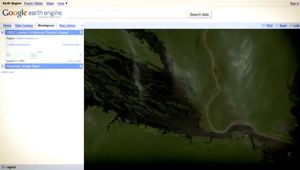
Google Launches Earth Engine for Carbon Accounting

EarthEngine

The tools were made available to rainforest nations in advance of this week’s climate talks as both a means of assessing carbon in their forests and as a testbed for system development. Earth Engine is not only a core platform for hosting imagery and other geospatial data, it is also an analysis processing framework with an Earth Engine API for scientists to write their own code to customize the platform for their area of interest. Google is also providing 20 million CPU hours for free to scientists and developing countries to take advantage of the new analytical tool.

Earth Engine has been a collaborative effort that has included contributions from Greg Asner of the Carnegie Institution for Science, Carlos Souza of Imazon and Matt Hansen of the Geographic Information Science Center at South Dakota State University.

It is hoped that this year’s talks will result in an agreement on the U.N. initiative known as Reducing Emissions from Deforestation and Forest Degradation in Developing Countries (REDD), and this tool will act as a means to monitor and enforce such an agreement, tracking environmental change and deforestation rates in real time.

View an explanatory video for more details or visit the Google Earth Engine website.