
Asian Surveying & Mapping
Breaking News
PLD Space increases investment in its Launch Complex at the Guiana Space Centre (CSG) to €35M, strengthening Europe’s sovereign space infrastructure
The investment is expected to generate approximately €21 million...
India seeks Singapore capital to fuel its ambitious private space sector
India aims to grow its space economy to US$44...
China conducts surprise launch of Long March 12B, delivers Qianfan satellites on debut flight
HELSINKI — China conducted the maiden launch of its...
ISRO to launch first unmanned Gaganyaan mission by year’s end
The Chairman of ISRO, Somnath said that the efforts...
ORF- RSIS Special Report Launch | India and Southeast Asia: Mapping Strategic Convergence in an Era of Great-Power Competition
In 2014, Prime Minister Narendra Modi announced India’s shift...
Israel defense ecosystem meets to accelerate fieldable counter‑drone tech
Sparked by a message from the frontlines, CET Sandbox...
Chinese startup Mega Engine advances reusable staged-combustion rocket engine
HELSINKI — A new Chinese commercial rocket engine startup...
Haryana wins Geospatial Excellence Award for agricultural innovation in Netherlands
Haryana has been internationally recognised for its technological innovation...
South Korean, Singaporean Entities Partner To Support Space Startup Expansion
SINGAPORE—BlueTide Capital and Singapore Space and Technology Think Tank...
Japan space startups to train engineers from India, Philippines, Indonesia
JICA program to coach professionals on satellite manufacturing, data...

April 9th, 2018
Sounding Rocket Experiments to Study Upper Atmosphere

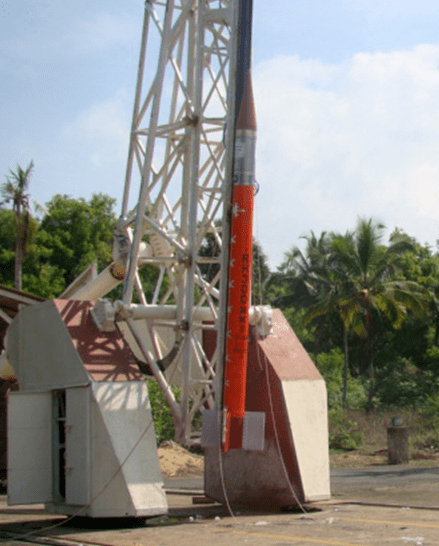
The 21st flight of ISRO’s RH300 Mk-II Sounding Rocket was launched on April 6, 2018, from the Thumba Equatorial Rocket Launching Station (TERLS), VSSC, Thiruvananthapuram. In this launch, the single-stage indigenous Sounding Rocket successfully expelled the chemical Trimethylaluminum (TMA) at altitudes between 90-108 kilometers, marking the first successful TMA experiment with an indigenous rocket.

Scientific objectives of the mission are to measure the ionospheric density and neutral winds in the E-Region of the ionosphere using two independent techniques as well as to cross validate the measurements of wind by these techniques, investigating the modulations in the neutral wind along with electron density at dynamo heights and their implications in providing a trigger for the generation of equatorial Plasma Bubble and assessing the role of wind shears in generation of E-region irregularities.

Click here for more information.