
Asian Surveying & Mapping
Breaking News
Korea courts global space partnerships as private sector takes lead
Korea's space industry seeks to turn its growing technological...
Japan’s ANA invests in space construction startup Space Quarters
Japan's ANA Holdings, the parent company of All Nippon...
UAE Space Agency connects Spanish space firms with local space industry
The UAE Space Agency and the Embassy of Spain...
Pakistani astronaut to join China’s next space station mission
The unnamed individual will be the first foreign national...
China’s Tianwen-4 Jupiter mission to attempt Callisto moon landing
HELSINKI — China’s space agency has issued a call...
Jio In Talks With ISRO, Skyroot For 1,600-Satellite Constellation: Report
Jio Platforms has begun talks with the Indian Space...
Etihad Cargo completes transportation of UAE-built space mission probe from UAE to the United States
With the probe’s design, build and testing now complete,...
Europe space chief heads to Gulf as bloc looks beyond US
Europe space chief heads to Gulf as bloc looks...
UK aims to launch space junk relocation mission in 2029
The UK is to use giant robotic claws to...
ISRO’s GSLV rocket carrying navigation satellite lifts off
NVS-03 is the third satellite in next generation navigation...

March 10th, 2026
Ailing “Megaberg” Sparks Surge of Microscopic Life 

Iceberg A-23A has had a more eventful run than most of the large Antarctic icebergs that have calved from the continent’s ice shelves in recent decades. Over its winding, 40-plus-year journey, the “megaberg”spent decades grounded in the Weddell Sea before drifting north, twirling in an ocean vortex for months, and nearly colliding with an island in 2025. 

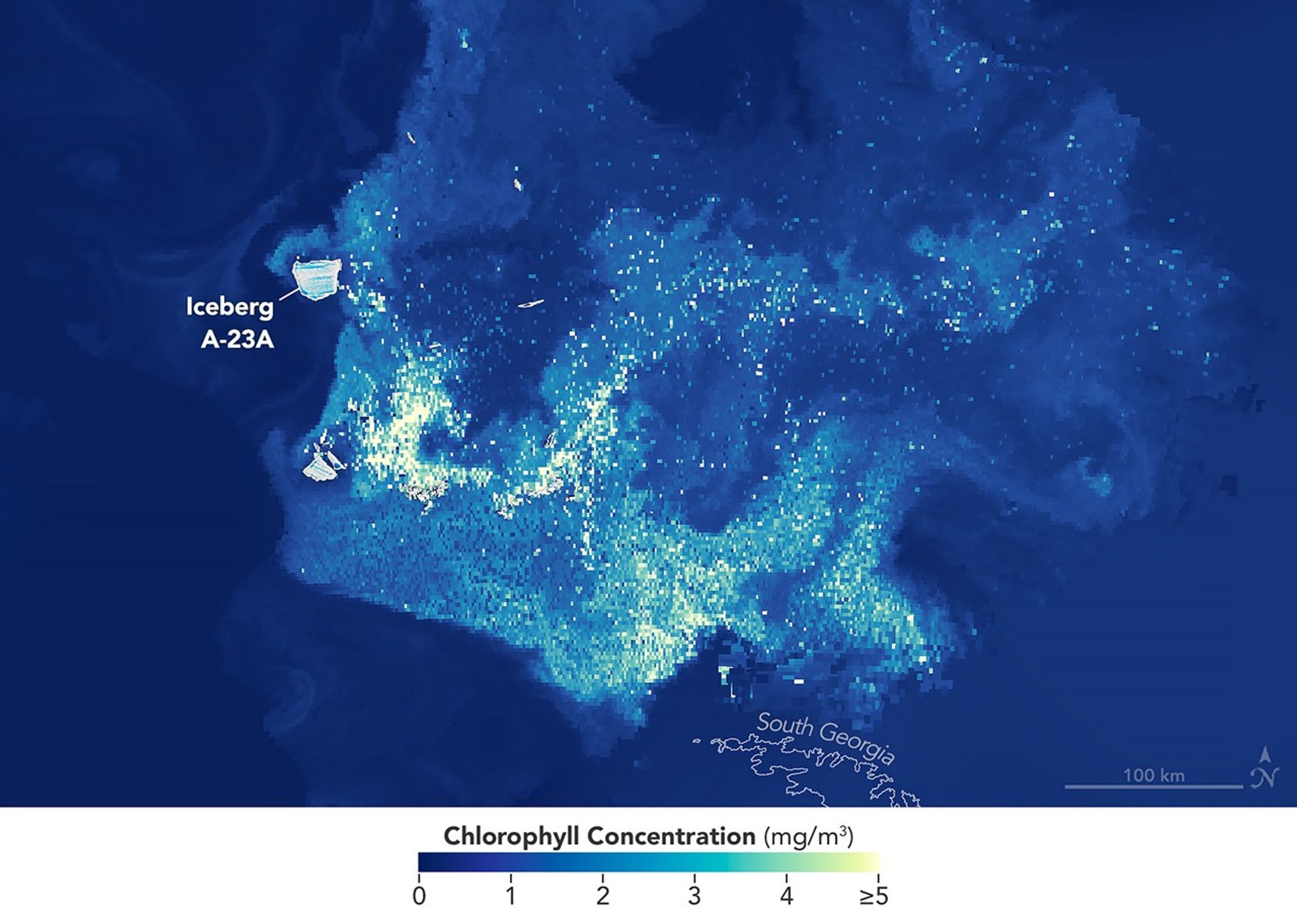
By 2026, the iconic iceberg, sopping with meltwater and shedding smaller bergs as it moved into warmer ocean waters, put on one more show. The chunks of ice and frigid glacial meltwater left in its wake appear to have fueled a surge in phytoplankton abundance, known as a bloom, observed in surface waters by NASA satellites. 

On Jan. 25, 2026, the OCI (Ocean Color Instrument) on NASA’s PACE (Plankton, Aerosol, Cloud, Ocean Ecosystem) satellite detected plumes of chlorophyll-a drifting around the remaining bergs and debris field. Researchers use chlorophyll concentrations as a marker of phytoplankton abundance. 

Image credit: NASA Earth Observatory images by Michala Garrison, using PACE data from the NASA Ocean Biology Distributed Active Archive Center OB.DAAC, and Landsat data from the U.S. Geological Survey.