
Asian Surveying & Mapping
Breaking News
EU and Korea deepen cooperation on secure satellite connectivity
Today, the European Commission and the Republic of Korea...
Ghana, Japan explore deeper cooperation in space technology
Ghana and Japan are exploring deeper cooperation in space...
China conducts four launches inside 48 hours as launch options diversify
HELSINKI — China carried out four launches in quick...
Dubai Municipality deploys smart robot for geospatial surveys
Dubai: Dubai Municipality has deployed a smart robot to...
India’s Geospatial Sector Gets Boost With Mirai-GreenValley LiDAR Partnership
Mirai Aerospace Systems and Software Solutions and US-based GreenValley...
From drones to space tech, Japan looks to startups to strengthen its defences
Tokyo is stepping up efforts to harness dual-use technologies...
South Korea’s Space Agency Seeks 47% Budget Hike for 2027; Regular Nuri Launches, Lunar Lander Development to Begin
The Korea AeroSpace Administration (KASA) has proposed a 2027...
Space42 launches Future Spacers Programme to develop UAE space talent
Space42, the UAE-based AI-powered SpaceTech company, has launched the...
US, China arm for space warfare: hunter satellites and orbital weapons
Amid the rapidly-evolving field of military space operations, Beijing...
ISRO Puts India’s First Geo Imaging Satellite In Orbit, PM Modi Hails EOS-05 Launch Aboard GSLV-F17
The Indian Space Research Organisation (Isro) successfully launched EOS-05,...

January 17th, 2023
Kilauea Erupts Again

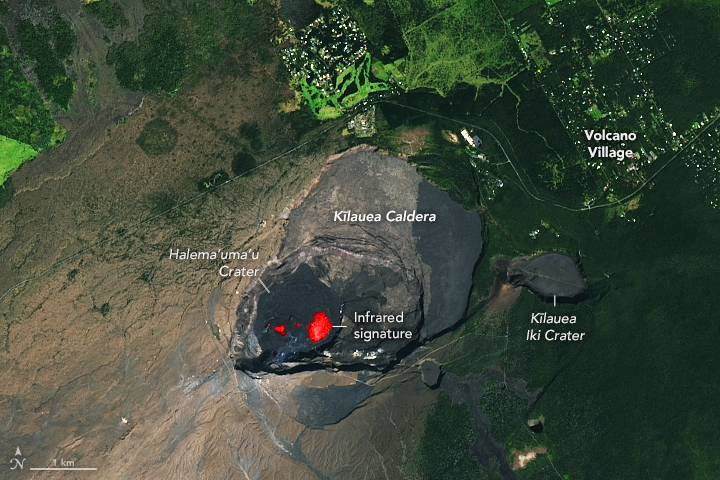
On Jan. 5, 2023, Kilauea—Hawaii’s youngest and most active volcano—began erupting once again. Scientists at the U.S. Geological Survey’s Hawaiian Volcano Observatory saw a glow in summit webcam images indicating that the eruption had resumed. They detected fissures at the base of Halema‘uma‘u crater, within the summit caldera, which generated lava flows. 

Multiple fountains of lava became active in Halema‘uma‘u crater on the afternoon of January 5. One large burst of lava reached 50 meters (164 feet) high and covered the crater floor with lava. By evening, lava had spilled across the crater at depths of about 10 meters (32 feet). 

The Operational Land Imager (OLI) on Landsat 8 acquired this image on Jan. 11, 2023.

Image Credit: NASA Earth Observatory image by Lauren Dauphin, using Landsat data from the U.S. Geological Survey.