
Asian Surveying & Mapping
Breaking News
PLD Space increases investment in its Launch Complex at the Guiana Space Centre (CSG) to €35M, strengthening Europe’s sovereign space infrastructure
The investment is expected to generate approximately €21 million...
India seeks Singapore capital to fuel its ambitious private space sector
India aims to grow its space economy to US$44...
China conducts surprise launch of Long March 12B, delivers Qianfan satellites on debut flight
HELSINKI — China conducted the maiden launch of its...
ISRO to launch first unmanned Gaganyaan mission by year’s end
The Chairman of ISRO, Somnath said that the efforts...
ORF- RSIS Special Report Launch | India and Southeast Asia: Mapping Strategic Convergence in an Era of Great-Power Competition
In 2014, Prime Minister Narendra Modi announced India’s shift...
Israel defense ecosystem meets to accelerate fieldable counter‑drone tech
Sparked by a message from the frontlines, CET Sandbox...
Chinese startup Mega Engine advances reusable staged-combustion rocket engine
HELSINKI — A new Chinese commercial rocket engine startup...
Haryana wins Geospatial Excellence Award for agricultural innovation in Netherlands
Haryana has been internationally recognised for its technological innovation...
South Korean, Singaporean Entities Partner To Support Space Startup Expansion
SINGAPORE—BlueTide Capital and Singapore Space and Technology Think Tank...
Japan space startups to train engineers from India, Philippines, Indonesia
JICA program to coach professionals on satellite manufacturing, data...

August 17th, 2020
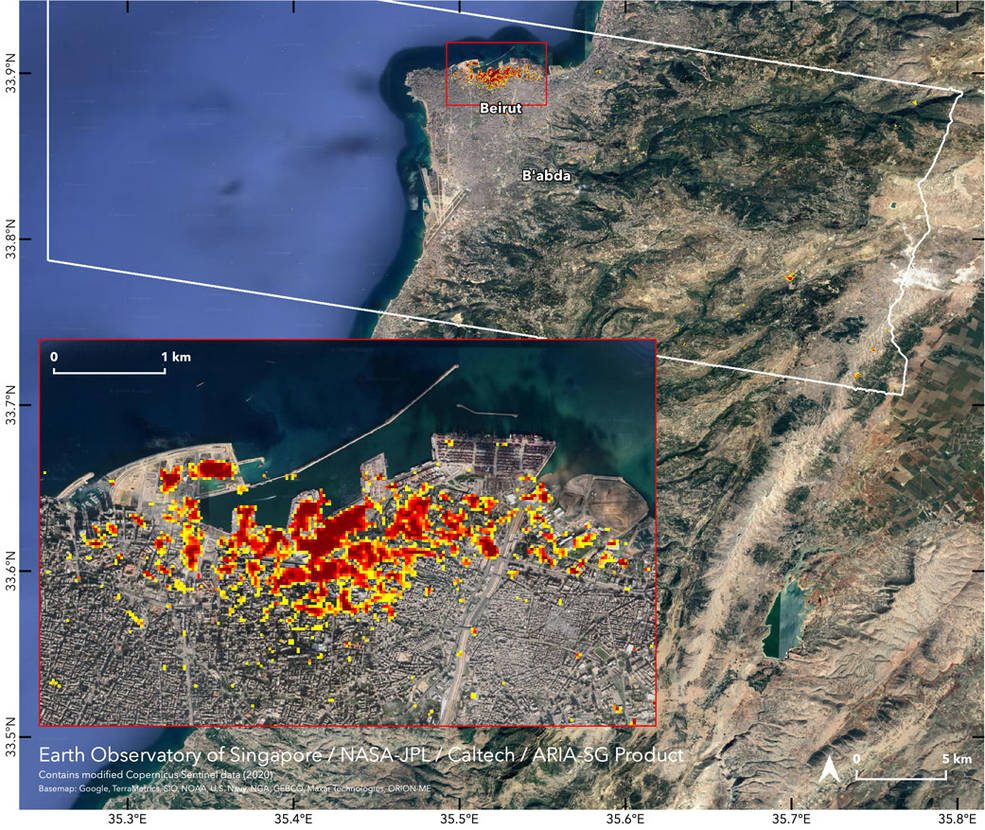
NASA Maps Beirut Blast Damage

NASA’s Advanced Rapid Imaging and Analysis (ARIA) team, in collaboration with the Earth Observatory of Singapore, used satellite-derived synthetic aperture radar data to map the likely extent of damage from a massive Aug. 4, 2020, explosion in Beirut. Synthetic aperture radar data from space shows ground surface changes from before and after a major event like an earthquake. In this case, it is being used to show the devastating result of an explosion.

On the map, dark red pixels—like those present at and around the Port of Beirut—represent the most severe damage. Areas in orange are moderately damaged, and areas in yellow are likely to have sustained somewhat less damage. Each colored pixel represents an area of 30 meters (33 yards).

Maps like this can help identify badly damaged areas where people may need assistance. The explosion occurred near the city’s port. It claimed more than 150 lives and is estimated to have caused billions of dollars’ worth of damage.

Image Credit: The map contains modified Copernicus Sentinel data processed by ESA (European Space Agency) and analyzed by ARIA team scientists at NASA JPL, Caltech, and Earth Observatory of Singapore.