
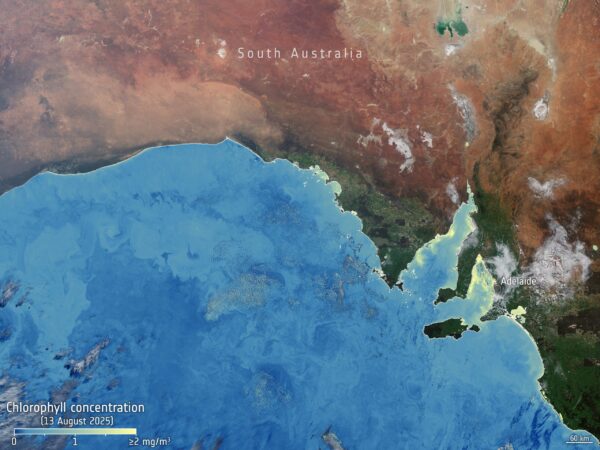
This image acquired by the Copernicus Sentinel-3 mission and its Ocean and Land Colour Instrument shows high concentrations of chlorophyll in yellow-green along the coastline of South Australia, near Adelaide. Chlorophyll is a key indicator of the presence of algae in the ocean.
The bloom, first detected in mid-March 2025 around the Fleurieu Peninsula, is caused by the marine dinoflagellate Karenia mikimotoi. For more than five months, it has persisted and fluctuated along the coast. While the algae is not classified as toxic to humans, it can irritate the skin and eyes and may cause respiratory discomfort. For marine life, however, it poses a serious threat, as it can damage the gills of fish and lead to death.
The Government of South Australia has linked the bloom to a prolonged marine heatwave that has been affecting southern Australia since September 2024. Karenia mikimotoi typically thrives in nutrient-rich, stratified waters where light and stability allow it to proliferate.
Image Credit: Contains modified Copernicus Sentinel data (2025), processed by ESA
