
Asian Surveying & Mapping
Breaking News
PLD Space increases investment in its Launch Complex at the Guiana Space Centre (CSG) to €35M, strengthening Europe’s sovereign space infrastructure
The investment is expected to generate approximately €21 million...
India seeks Singapore capital to fuel its ambitious private space sector
India aims to grow its space economy to US$44...
China conducts surprise launch of Long March 12B, delivers Qianfan satellites on debut flight
HELSINKI — China conducted the maiden launch of its...
ISRO to launch first unmanned Gaganyaan mission by year’s end
The Chairman of ISRO, Somnath said that the efforts...
ORF- RSIS Special Report Launch | India and Southeast Asia: Mapping Strategic Convergence in an Era of Great-Power Competition
In 2014, Prime Minister Narendra Modi announced India’s shift...
Israel defense ecosystem meets to accelerate fieldable counter‑drone tech
Sparked by a message from the frontlines, CET Sandbox...
Chinese startup Mega Engine advances reusable staged-combustion rocket engine
HELSINKI — A new Chinese commercial rocket engine startup...
Haryana wins Geospatial Excellence Award for agricultural innovation in Netherlands
Haryana has been internationally recognised for its technological innovation...
South Korean, Singaporean Entities Partner To Support Space Startup Expansion
SINGAPORE—BlueTide Capital and Singapore Space and Technology Think Tank...
Japan space startups to train engineers from India, Philippines, Indonesia
JICA program to coach professionals on satellite manufacturing, data...

March 24th, 2026
Tropical Cyclone Narelle Crosses Australia 

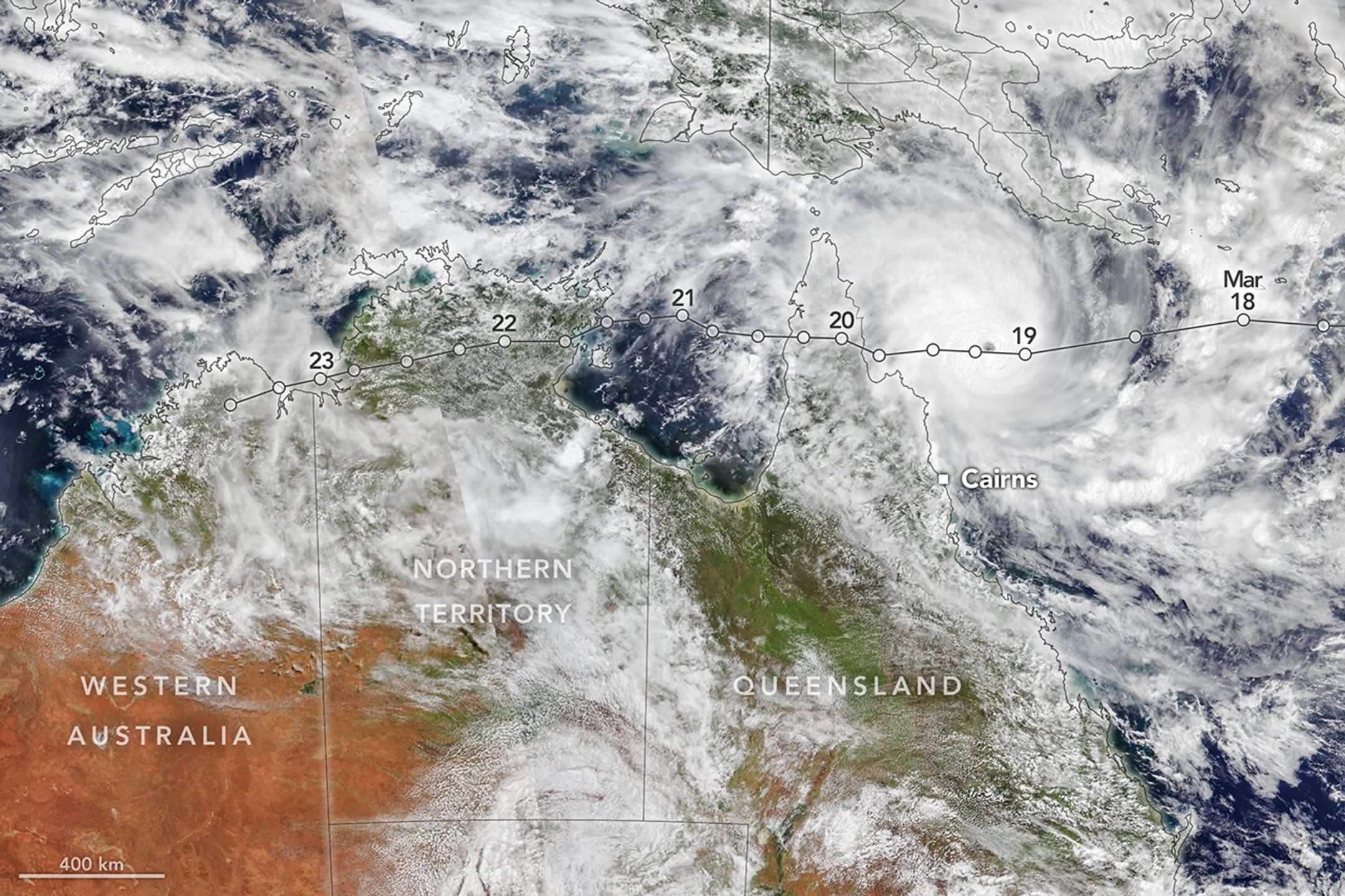
Tropical Cyclone Narelle traced a long path across the northern edge of Australia, bringing damaging winds and rain to areas already saturated with abundant precipitation. The system made separate landfalls in three different states and territories between March 20-23, 2026. 

The accompanying satellite image from the VIIRS (Visible Infrared Imaging Radiometer Suite) on the NOAA-21 satellite shows Narelle on March 19. By that time, the tropical cyclone was poised to make its first and most powerful landfall after intensifying over the Coral Sea. Sea surface temperatures along its path were 0.5–1.0 degrees Celsius above average, experts noted, which helped fuel its rapid intensification. 

As it approached Queensland, the storm intensified to a category 5 on Australia’s tropical cyclone scale with maximum sustained winds up to 225 kilometers (140 miles) per hour—equivalent to a category 4 hurricane on the Saffir-Simpson wind scale. However, because Narelle’s structure was compact by cyclone standards, the most damaging winds extended a relatively short distance from its core. Narelle reached the Cape York Peninsula, a sparsely populated region in northern Queensland, on the morning of March 20. 

Image credit: NASA Earth Observatory/Michala Garrison