
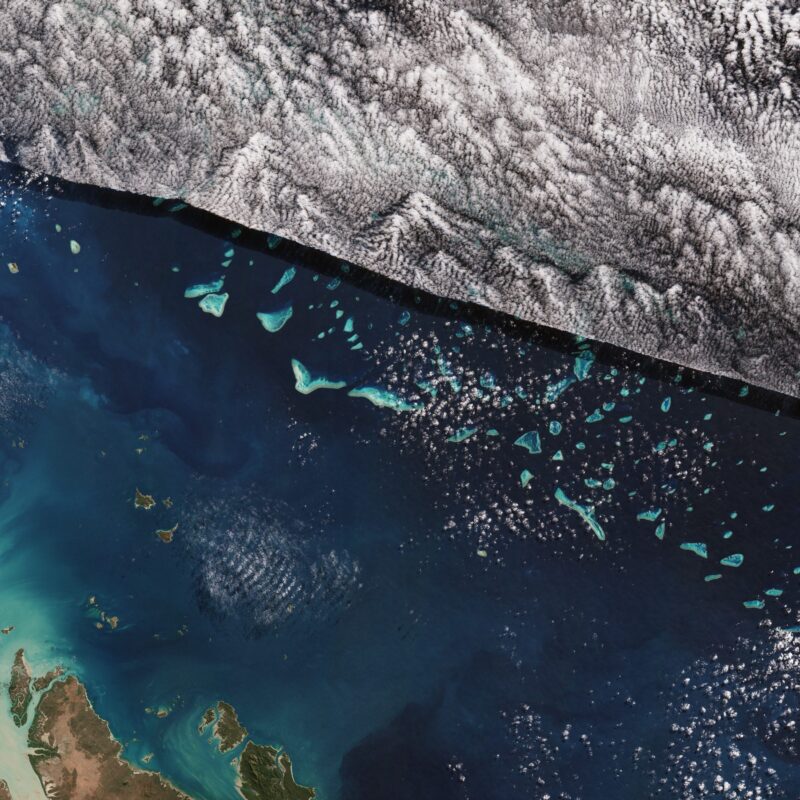
This Copernicus Sentinel-2 image shows part of one of the world’s natural wonders: the Great Barrier Reef in the Coral Sea off the east coast of Queensland, Australia.
The Great Barrier Reef extends for nearly 2,300 kilometers and covers an area of more than 344,000 square kilometers, approximately the size of Italy. It’s the largest living organism on Earth and the only living thing the naked eye can see from space.
Despite its name, the Great Barrier Reef is not a single reef, but an interlinked system of about 3,000 reefs and 900 coral islands, divided by narrow passages. An area of biodiversity equal in importance to tropical rainforests, the reef hosts more than 1,500 species of tropical fish, 400 types of coral, hundreds of species of bird and seaweed, and thousands of marine animals, including sharks, barracuda and turtles. In recognition of its significance the reef was made a UNESCO World Heritage Site in 1981.
The section of reef seen here is the southern part off the coast of the Shire of Livingstone in Central Queensland. Part of the mainland and the islands surrounding the coast are visible in the bottom left corner. The tan-colored sea along the coasts is due to sediment in the water.
A chain of small coral islands can be seen scattered across the center of the image. The blue hues of the coral contrast with the dark waters of the Coral Sea.
Part of the reef is covered by clouds dominating the upper part of the image. The clouds form a surprisingly straight line, also visible as a distinct shadow cast over the islands below.
Image Credit: Contains modified Copernicus Sentinel data (2024), processed by ESA
