
Asian Surveying & Mapping
Breaking News
Genesys International bags ₹283 crore World Bank-funded contract for Ahmedabad digital twin
The project will map 625 sq km, survey 25...
China launches new remote sensing satellite group
TAIYUAN, Sept. 24 (Xinhua) -- China launched a new...
Ahmad Belhoul Al Falasi to lead UAE delegation at IAC 2026
UAE delegation will bring together government entities, research institutions...
Korea Signs Space Cooperation MOU With Mexico
A path is opening for domestic space companies to...
China’s space diplomacy lifts Pakistani astronaut toward orbit
KARACHI, Sept 28 (Reuters) - Two Pakistani pilots are...
NV5 Global stock expands geospatial reach with $303 million deal
NV5 Global stock is linked to a Quantum Spatial...
EU and Korea deepen cooperation on secure satellite connectivity
Today, the European Commission and the Republic of Korea...
Ghana, Japan explore deeper cooperation in space technology
Ghana and Japan are exploring deeper cooperation in space...
China conducts four launches inside 48 hours as launch options diversify
HELSINKI — China carried out four launches in quick...
Dubai Municipality deploys smart robot for geospatial surveys
Dubai: Dubai Municipality has deployed a smart robot to...

October 17th, 2017
Invisible Solar Nanoflares Confirmed by Ultra-High-Sensitivity Observations

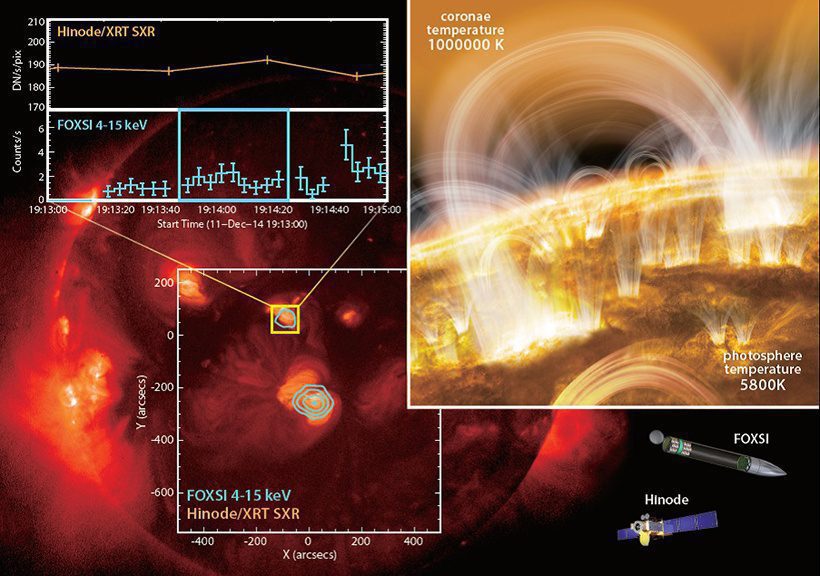
An international research team led by Dr. Shin-nosuke Ishikawa, project research fellow of the Japan Aerospace Exploration Agency (JAXA), succeeded in detecting the subtle signs of nanoflares in a region of the solar corona where no discernible flare activity was taking place. The finding was made by a combination of hard x-ray data from the FOXSI (Focusing Optics X-ray Solar Imager) sounding rocket experiment and data from Hinode solar observatory.

The frequent occurrence of nanoflares has been regarded as a promising agent for maintaining the solar corona at a high temperature of several million Kelvin. The result from the research group is expected to put strong constraints to theories accounting for coronal heating. The results will be published in Nature Astronomy.

Photo Credit: National Research and Development Agency, Japan Aerospace Exploration Agency (JAXA), Inter-University Research Institute Corporation, National Institutes of Natural Sciences, National Astronomical Observatory of Japan (NAOJ)