
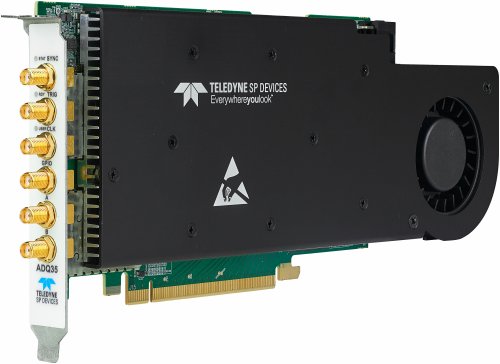
Teledyne SP Devices recently announced a major advancement in high‑speed data acquisition through the combined capabilities of its high-speed ADQ3 data acquisition board family and the proprietary libads NVMe streaming library. Together, these technologies enable sustained multi‑tens‑of‑gigabytes‑per‑second disk write performance, supporting long‑duration data acquisition and recording for applications such as wideband signal collection, radar analysis, satellite monitoring, and scientific instrumentation.
Why High‑Speed Disk Streaming Matters
Modern data acquisition systems routinely generate tens of gigabytes per second of high‑fidelity data. Traditional file‑system‑based storage methods introduce latency, limit throughput, and cannot maintain continuous recording at full digitizer speed. To overcome these limitations, Teledyne SP Devices developed libads, a high‑performance NVMe streaming library that performs direct, block‑level writes to SSD arrays. By bypassing the operating system entirely, libads removes bottlenecks and delivers the sustained performance required for uninterrupted, high‑speed data capture when paired with the ADQ35 digitizer.
Disk Streaming Architecture
High‑performance disk streaming depends on efficient, deterministic data movement from digitizer to storage. At the core of this architecture is the ADQ35, which operates at up to 10 GSPS in single‑channel mode or 5 GSPS in dual‑channel mode, generating 20 GB/s of raw data. Its PCIe Gen3 interface supports up to 14 GB/s host transfer bandwidth per device, forming the foundation for extreme‑speed data capture.
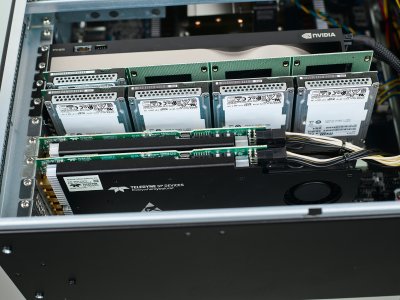
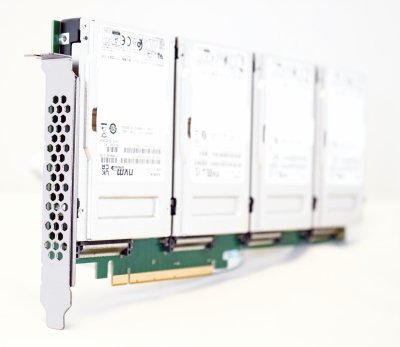
A suitable host PC must provide enough PCIe Gen4 or Gen5 x16 slots to accommodate digitizers, GPUs, and NVMe carrier boards without introducing bottlenecks. PCIe bifurcation or PCIe switches are often used to attach multiple NVMe drives in parallel. RAID arrays can be built using enterprise‑class NVMe SSDs such as the Kioxia CD8 for consistent long‑duration write performance, or high‑end consumer SSDs for cost‑efficient burst recording where SLC cache limitations are acceptable. By writing directly to raw disk sectors, libads minimizes overhead and maximizes throughput.
The Role of libads
libads manages direct data streaming from the ADQ35 to NVMe drives using large, contiguous block writes. This approach enables sustained write rates exceeding 25 GB/s in suitable RAID configurations, while maintaining deterministic performance with minimal jitter. The library scales from compact systems to petabyte‑class RAID arrays and keeps CPU overhead low, allowing the host processor to focus on supervision or optional real‑time processing, including GPU‑accelerated workflows.
Example Storage Configurations
Enterprise‑class RAID systems built from five high‑performance SSDs—such as five Kioxia CD8 drives—can deliver sustained write speeds of 25 GB/s or more with total capacities around 75 TB. This configuration is ideal for multi‑hour recordings at full digitizer speed, offering consistent long‑term performance without throughput degradation.
For more cost‑sensitive environments, a configuration using two high‑end consumer NVMe drives, such as the Kingston Fury Renegade G5, provides high burst write speeds suitable for several hundred gigabytes of recording. While performance tapers once the SLC cache is exhausted, this approach remains attractive for shorter captures or budget‑constrained applications.
Performance Considerations
Achieving maximum throughput depends on several factors, including proper PCIe lane allocation, the use of large block transfer sizes, the endurance and sustained performance characteristics of the selected SSDs, and adequate thermal management to prevent drive throttling during long‑duration recording.
Learn more on our website: www.spdevices.com?utm_source=mepax
