
TORONTO, Ontario, Canada – Space Flight Laboratory (SFL) has been contracted to support development of Clusters 7 through 11 in the HawkEye 360 radio frequency (RF) geolocation microsatellite constellation. Under the Flex Production program, SFL is designing, assembling, and integrating Cluster 9 at its Toronto headquarters and is providing technical support for the integration of Clusters 7, 8, 10 and 11 at HawkEye 360’s new manufacturing facility in Virginia. Each cluster includes three microsatellites.
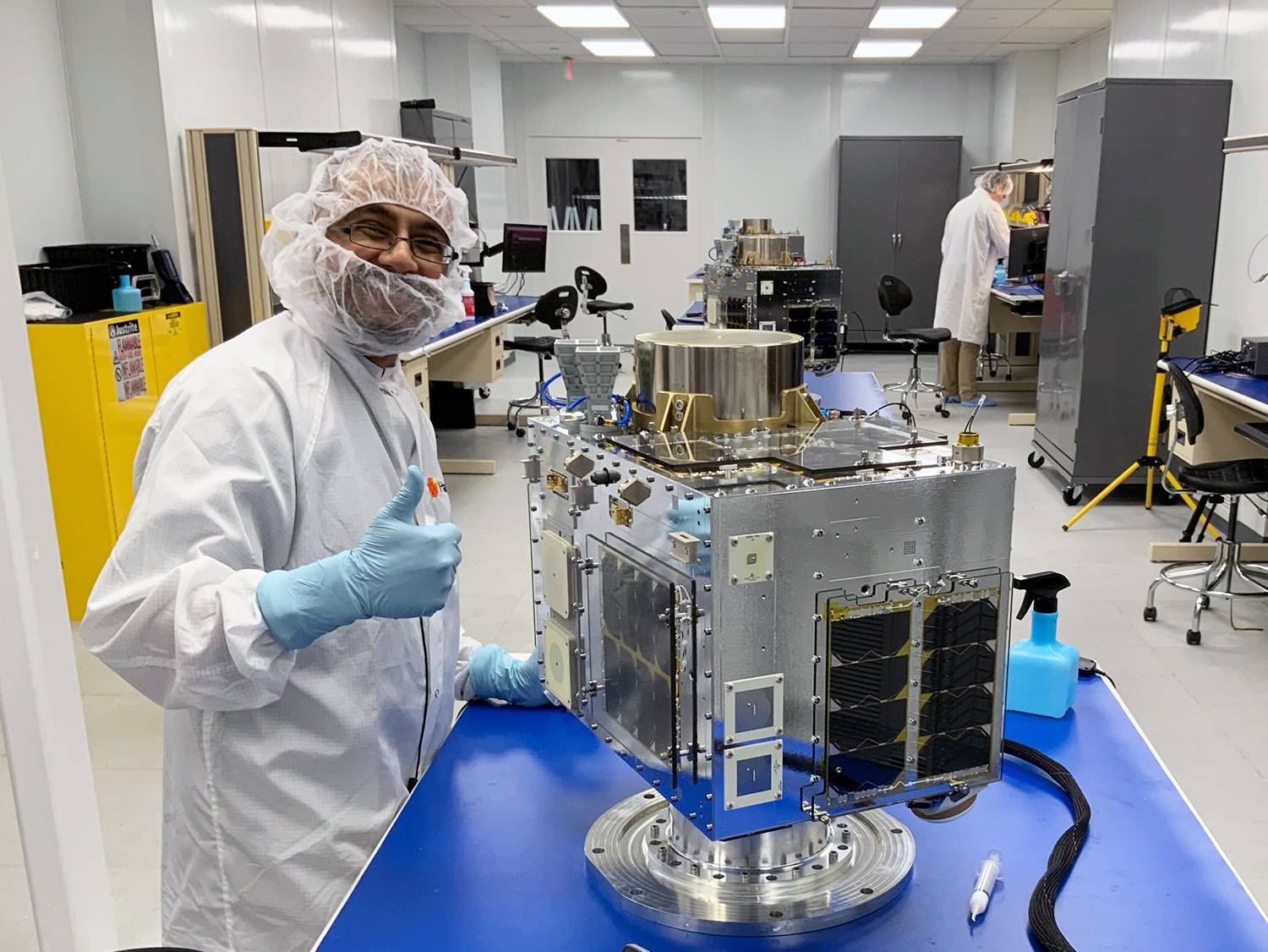
HawkEye 360 staff complete integration of Cluster 7 satellites with technology and training from SFL. (Photo courtesy HawkEye 360).
Created with NewSpace companies in mind, the SFL Flex Production program gives customers the option of contracting SFL to completely develop the first satellite, or satellite cluster, in a Microspace constellation at its Toronto facility. SFL then assists the customer in setting up subsequent mass production at their own site or another site. However, development can shift back to SFL when a new spacecraft design or technology update is needed.
“Flex Production offers NewSpace companies the best of two worlds – they can leverage SFL’s Microspace expertise while satisfying the financial requirements of the NewSpace business model,” said SFL Director Dr. Robert E. Zee. “NewSpace companies can mass produce satellites inhouse at a price point that works for them.”
Designing new satellites and upgrading technologies require workflows and personnel that are often different from the processes related to production of duplicate follow-on spacecraft, Zee explained. Progressive development of smaller satellite technology is the strength of Microspace businesses like SFL, he added.
Under the Flex Production program, SFL offers customers a variety of options as to the level of production they want to bring inhouse. For customers without their own production capabilities, SFL continues to maintain the capacity to develop complete smallsat, microsatellite, nanosatellite, and CubeSat missions in Toronto. SFL also has third-party partnerships to mass produce satellites at another facility when high volume and/or rapid cadence is required.
The HawkEye 360 Constellation detects and geolocates RF signals for maritime situational awareness, emergency response, national security, and spectrum analysis applications. Each new cluster expands HawkEye 360’s global revisit and collection capacity.
SFL developed the three-satellite Pathfinder Cluster on its 15-kg NEMO bus and then built Clusters 2, 3, 4, 5, and 6 on its space-proven 30-kg DEFIANT microsatellite bus. The first five clusters are now operating successfully in orbit with Cluster 6 expected to launch on Rocket Lab’s inaugural Electron mission from Wallops Island, Va., as early as December 2022.
SFL has been selected for the HawkEye 360 missions due to the importance of formation flying by multiple satellites for successful RF geolocation. SFL is the acknowledged leader in developing and implementing high-performance attitude control systems that make it possible for relatively low-cost nanosatellites and microsatellites to fly in stable formations while in orbit.
SFL is a unique microspace provider that offers a complete suite of nano-, micro- and small satellites – including high-performance, low-cost CubeSats – that satisfy the needs of a broad range of mission types from 3 to 500 kilograms. Dating from 1998, SFL’s heritage includes 61 operational successes and 30 currently under construction or awaiting launch. These missions relate to Earth observation, atmospheric monitoring, ship tracking, communication, radio frequency (RF) geolocation, technology demonstration, space astronomy, solar physics, space plasma, and other scientific research.
In its 24-year history, SFL has developed CubeSats, nanosatellites, and microsatellites that have achieved more than 215 cumulative years of operation in orbit. These microspace missions have included SFL’s trusted attitude control and, in some cases, formation-flying capabilities. Other core SFL-developed components include modular (scalable) power systems, onboard radios, flight computers, and control software.
About Space Flight Laboratory (SFL) (www.utias-sfl.net)
SFL generates bigger returns from smaller, lower cost satellites. Small satellites built by SFL consistently push the performance envelope and disrupt the traditional cost paradigm. Satellites are built with advanced power systems, stringent attitude control and high-volume data capacity that are striking relative to the budget. SFL arranges launches globally and maintains a mission control center accessing ground stations worldwide. The pioneering and barrier-breaking work of SFL is a key enabler to tomorrow’s cost-aggressive satellites and constellations. (www.utias-sfl.net)
Download the specification sheet for all SFL platforms here.
