
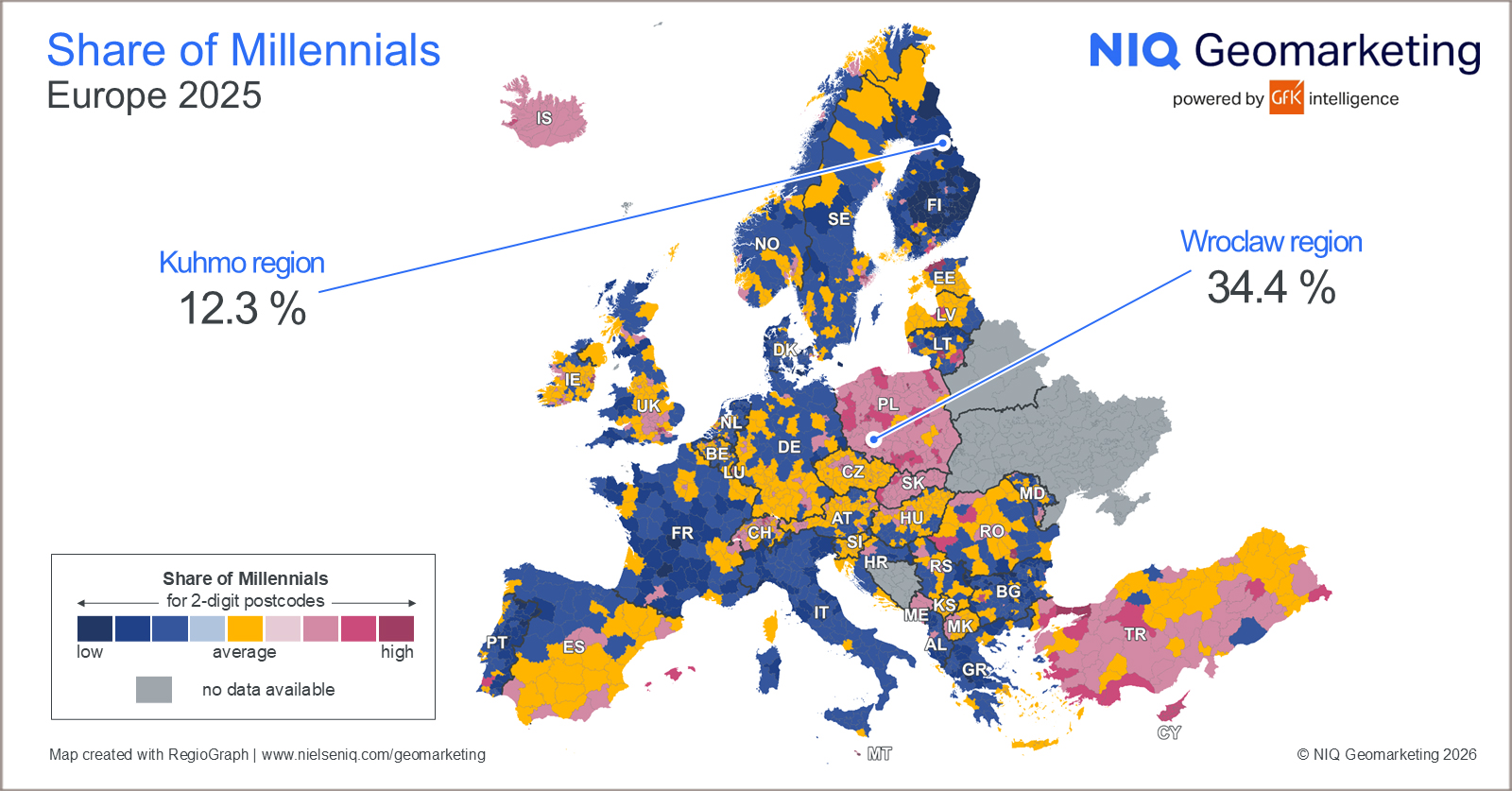
Our Geomarketing Map of the Month for September shows the regional distribution of Millennials (aged 30 to 45) across 39 European countries in 2025.
The highest shares of Millennials are primarily found in Europe’s urban centers. The leading region is Wroclaw in Poland, where Millennials account for 34.4 percent of the population. At the other end of the ranking are rural and peripheral regions, most notably the area around Kuhmo in northeastern Finland, where Millennials represent just 12.3 percent of the population. Overall, the results highlight the strong geographical concentration of this generation in larger cities and economically dynamic regions across Europe.
This distribution is also interesting in the context of smart stores. Smart stores are often regarded as a solution to supply gaps in rural areas. At the same time, in urban environments these concepts appeal to consumer groups that are particularly receptive to digital offerings and convenience-oriented shopping experiences. Millennials are a key example of such a group. They are often faced with the challenge of balancing professional and family responsibilities. As a result, convenience, flexibility, and a seamless shopping experience are especially important to many Millennials.
Download the map in high-resolution JPG format…
Further insights into the development and situation of the European retail sector can be found in our recent press release. The complete study “European retail in 2025 und 2026” is available for free download at www.nielseniq.com/european-retail-study.
The map may be freely distributed and reproduced if the following attribution is included: “Illustration: NIQ Geomarketing”.
Further insights into NIQ Geomarketing’s market data offering can be found here.
