
Asian Surveying & Mapping
Breaking News
EU and Korea deepen cooperation on secure satellite connectivity
Today, the European Commission and the Republic of Korea...
Ghana, Japan explore deeper cooperation in space technology
Ghana and Japan are exploring deeper cooperation in space...
China conducts four launches inside 48 hours as launch options diversify
HELSINKI — China carried out four launches in quick...
Dubai Municipality deploys smart robot for geospatial surveys
Dubai: Dubai Municipality has deployed a smart robot to...
India’s Geospatial Sector Gets Boost With Mirai-GreenValley LiDAR Partnership
Mirai Aerospace Systems and Software Solutions and US-based GreenValley...
From drones to space tech, Japan looks to startups to strengthen its defences
Tokyo is stepping up efforts to harness dual-use technologies...
South Korea’s Space Agency Seeks 47% Budget Hike for 2027; Regular Nuri Launches, Lunar Lander Development to Begin
The Korea AeroSpace Administration (KASA) has proposed a 2027...
Space42 launches Future Spacers Programme to develop UAE space talent
Space42, the UAE-based AI-powered SpaceTech company, has launched the...
US, China arm for space warfare: hunter satellites and orbital weapons
Amid the rapidly-evolving field of military space operations, Beijing...
ISRO Puts India’s First Geo Imaging Satellite In Orbit, PM Modi Hails EOS-05 Launch Aboard GSLV-F17
The Indian Space Research Organisation (Isro) successfully launched EOS-05,...

April 11th, 2022
Flooding in Eastern Australia

Just more than three months into 2022, Sydney, Australia, has already received a year’s worth of rain. The recent deluge brought more flooding to the already rain-soaked southern and central coasts of New South Wales, prompting evacuations.

On April 7, torrential downpours brought a month’s worth of precipitation—more than 100 millimeters (4 inches) —to parts of the city. The storm pushed rain gauges past 1,223 millimeters (48 inches) for the year, leaving them 10 millimeters (0.4 inches) above the mean annual rainfall in early April.

The excessive rain began in late 2021 with the rainiest November on record. It continued with more rain and flooding in February and March 2022. On March 9, Australia declared a national emergency.

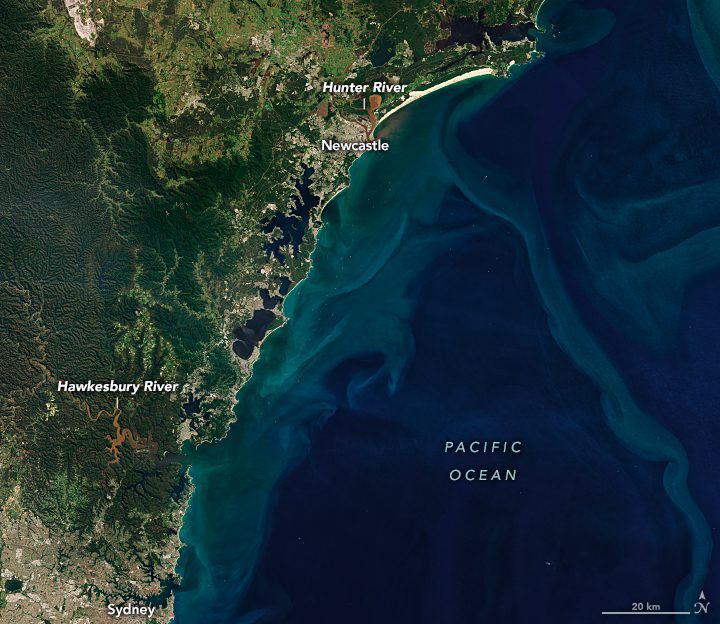
The ground was saturated and rivers were swollen when the Operational Land Imager-2 (OLI-2) on Landsat 9 acquired these images on April 4, 2022. The ongoing impacts of flooding can be seen in the muddy rivers, inundated land and sediment plumes draining from rivers along the coast.

Near the top of the image, north of Newcastle, a large lobe of brown floodwater has inundated the Hunter Wetlands. A plume of sediment also can be seen discharging from the mouth of the Hunter River and flowing along the beach in Worimi National Park. Sydney and its harbor can be seen at the bottom left of the image.

Image Credit: NASA Earth Observatory image by Joshua Stevens, using Landsat data from the U.S. Geological Survey