
Asian Surveying & Mapping
Breaking News
Singapore unveils road map to help develop international business standards and conformance
Singapore has unveiled plans to help develop international standards...
Adelaide University to run space and defence venture launchpad ahead of Australian Space Forum
Adelaide University’s Innovation & Collaboration Centre (ICC) will deliver...
Japan’s H3 rocket returns to space with successful launch after December setback
Japan’s flagship H3 rocket has returned to flight six...
KONGSBERG accelerates seabed mapping developments with Ocean Exploration Trust expedition aboard Exploration Vessel Nautilus
KONGSBERG and the Ocean Exploration Trust (OET) are set...
Russian satellites linked to mysterious GPS disruptions across several countries
Since 2019, GPS signals across Europe, Greenland and Canada...
Isro’s Bahubali LVM3 that launched Chandrayaan-3 to be handed to private sector
IN-SPACe has invited Indian companies to take over the...
India to host 13th UN Global Geospatial Information Management Asia-Pacific Conference
India is hosting the 13th United Nations Global Geospatial...
Unseenlabs’ BRO-22 to Become the First Foreign Private Satellite Launched Aboard Japan’s H3 Launch Vehicle
Scheduled for June 10, between 09:53 and 11:52 a.m....
PLD Space increases investment in its Launch Complex at the Guiana Space Centre (CSG) to €35M, strengthening Europe’s sovereign space infrastructure
The investment is expected to generate approximately €21 million...
India seeks Singapore capital to fuel its ambitious private space sector
India aims to grow its space economy to US$44...

December 10th, 2024
Map of the Month: GfK Purchasing Power for Sweets, Germany 2024

Our Geomarketing Map of the Month for December shows the regional distribution of purchasing power for sweets in Germany in 2024.

In 2024, every German spends an average of 245 euros on sweets, and with that more than on any other food group. However, the spending potential varies considerably depending on the region. With a per capita purchasing power of 301 euros, the Starnberg district takes first place, putting the Starnbergers almost 23 percent above the national average. In second and third place are the urban district of Neustadt an der Weinstrasse and the Rhein-Kreis Neuss district, each with 294 euros per capita and 20 percent more available spending potential than the average German. Bringing up the rear is the urban district of Gelsenkirchen, where residents only have 203 euros per person available for sweets. This corresponds to 83 percent of the German average.
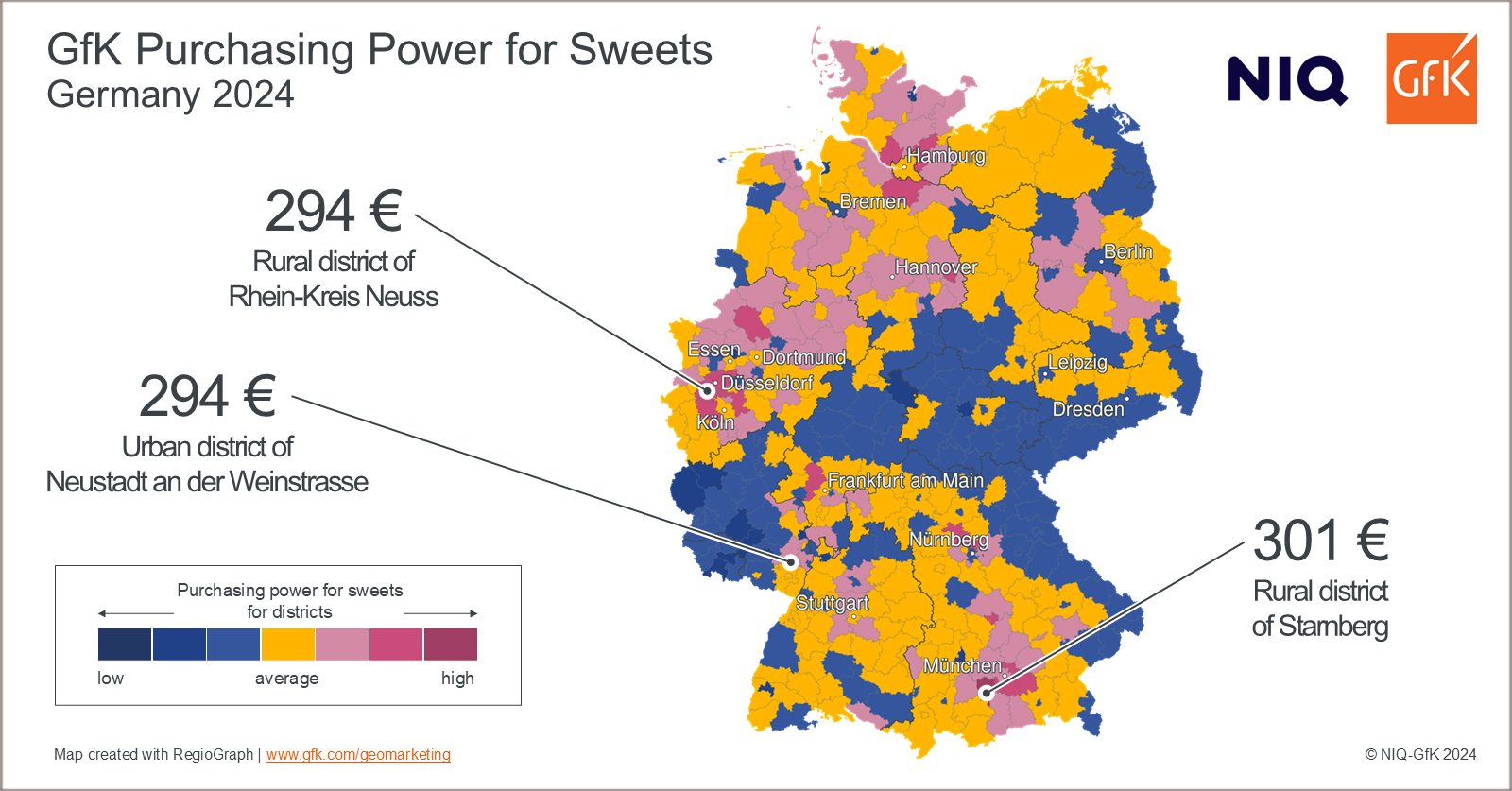
Map of regional distribution of purchasing power for sweets in Germany in 2024

Download the map in high-resolution JPG format…

The map may be freely distributed and reproduced if the following attribution is included: “Illustration: NIQ-GfK”.

Further insights into NIQ-GfK’s market data offering can be found here.