
Asian Surveying & Mapping
Breaking News
PLD Space increases investment in its Launch Complex at the Guiana Space Centre (CSG) to €35M, strengthening Europe’s sovereign space infrastructure
The investment is expected to generate approximately €21 million...
India seeks Singapore capital to fuel its ambitious private space sector
India aims to grow its space economy to US$44...
China conducts surprise launch of Long March 12B, delivers Qianfan satellites on debut flight
HELSINKI — China conducted the maiden launch of its...
ISRO to launch first unmanned Gaganyaan mission by year’s end
The Chairman of ISRO, Somnath said that the efforts...
ORF- RSIS Special Report Launch | India and Southeast Asia: Mapping Strategic Convergence in an Era of Great-Power Competition
In 2014, Prime Minister Narendra Modi announced India’s shift...
Israel defense ecosystem meets to accelerate fieldable counter‑drone tech
Sparked by a message from the frontlines, CET Sandbox...
Chinese startup Mega Engine advances reusable staged-combustion rocket engine
HELSINKI — A new Chinese commercial rocket engine startup...
Haryana wins Geospatial Excellence Award for agricultural innovation in Netherlands
Haryana has been internationally recognised for its technological innovation...
South Korean, Singaporean Entities Partner To Support Space Startup Expansion
SINGAPORE—BlueTide Capital and Singapore Space and Technology Think Tank...
Japan space startups to train engineers from India, Philippines, Indonesia
JICA program to coach professionals on satellite manufacturing, data...

May 28th, 2024
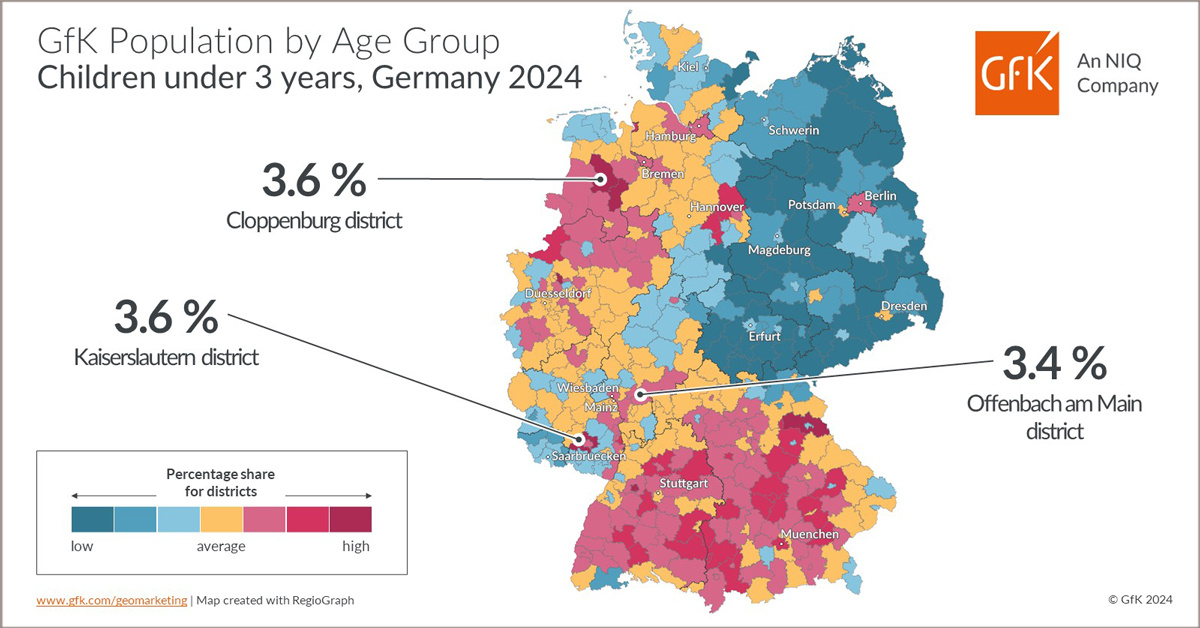
Map of the Month: GfK Population by Age Group, Children younger than 3 years, Germany 2024

GfK’s Map of the Month for May shows the regional distribution of babies and toddlers under the age of three in Germany in 2024.

According to the Federal Institute for Population Research (BiB), the birth rate in Germany is the lowest it has been since 2009. But which German regions have the highest share of children under the age of three?

The latest GfK data on population by age group shows that there is a clear east-west divide in Germany in this respect. The highest share of babies and toddlers younger than three years can be found in the western German federal states, especially in the districts of Cloppenburg and Kaiserslautern, where they make up 3.6 percent of all residents. This puts both districts more than 28 percent above the German average. Third place is taken by the district of Offenbach am Main with 3.4 percent. Bringing up the rear is the Thuringian district of Suhl: at 1.9 percent, the share of children under the age of three is more than 31% below the national average.
Download the map in high-resolution JPG format…

The map may be freely distributed and reproduced if the following attribution is included: “Illustration: GfK”.

Further insights into GfK’s market data offering can be found here.