
Singapore – At the Asia Pacific (APAC) Smart Campus Solution Launch 2021, Huawei released its Smart Campus Solution in the region, inviting industry customers, partners, experts, and medias across APAC to seize the opportunities brought by Information and Communication Technology (ICT) and the integration of industry forces, in order to jointly promote the development of the smart campus industry.
In his opening remarks, Bob Chen, the Vice President of the Huawei Enterprise Business Group (BG), noted that APAC’s smart campus market now exceeds US$10 billion in value, according to a third party report. He also detailed how Huawei is committed to promoting digitalization and is, in fact, already building secure, smart, and green campuses for different customers and stakeholders. “Huawei has completed 500 smart campus projects around the world, helping our customers achieve business success,” Chen said. “We look forward to continuing to work with our customers, to deal with challenges as we build a smart world together.
Bob Chen, the Vice President of the Huawei Enterprise Business Group (BG)
Tony Khoo, the President of the Singapore International Facility Management Association (SIFMA) also spoke at the opening of the event. “As ICT advances, system construction gets more and more complex, with campuses getting bigger and bigger. It is therefore becoming harder to manage them and there is an urgent need for us to understand them better and manage them smarter. The launch of this Smart Campus Solution is timely, providing many of our members with the solution that they’ve been looking for.”
The fully connected, intelligent world is approaching. Campuses will serve as the basic unit of cities, carriers of both work and life. As such, our entire society will be enhanced by improving campus efficiency and experience. Winson Wang, Head Partner Alliance, APAC Enterprise Business Group Openlab introduced the latest Huawei Smart Campus Solution which Huawei redefines the smart campus by building a secure, open, and sustainable digital platform that integrates new ICT technologies such as cloud computing, Internet of Things (IoT), artificial intelligence (AI), and mobile interconnection.
The biggest difference between a smart campus and a traditional campus lies in the upper-layer brain, including the Intelligent Operation Center (IOC) platform and smart applications, and the key ICT infrastructure is as follows:
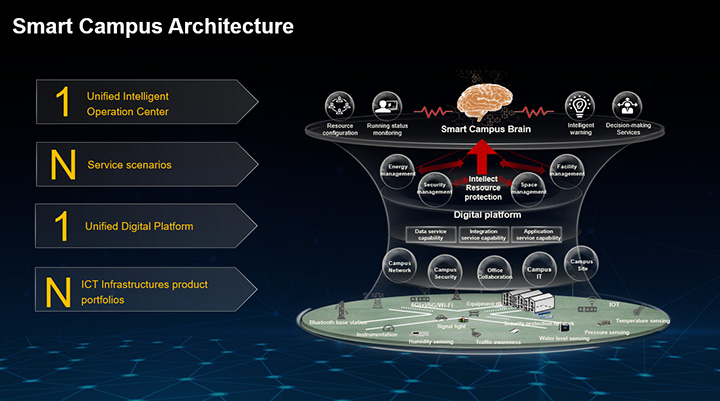
Huawei Smart Campus Architecture
Tony Shi, the CTO of Huawei APAC Scenario Based Solution also demonstrated on how the innovative digital platforms are able to meet the three major use cases: ubiquitous connectivity, integrated management and new service development. With the digital platform integrated with Video Cloud, IoT, Internet Communications Protocol (ICP), Geographic Information System (GIS) and other new technologies, customers could leverage on the platform to design, develop and verify solutions to create a secure, comfortable, efficient and green campus.
SIFMA Board Member and Executive Director and Head of Workplace Singapore for JLL, G. Segar, shared insights for smart campus development trends. He stated that developments in technology have brought great advantages in system integration, noting that Huawei is taking the lead here. Indeed, its investments in Research and Development (R&D) ensure that its products and solutions are capable of creating a better experience, with improved monitoring capabilities, communication channels, and a data platform delivering high-quality actionable insights. SIFMA will continue to play its part in identifying new technology and technology developers, such as Huawei, for SIFMA’s corporate and individual members.
The APAC Smart Campus Solution Launch 2021 also gathered together industry experts and Huawei’s customers — including SIFMA, Dalian Hi-Think Computer Technology, and DTGO, as well as Huawei’s own APAC Enterprise experts — for a panel discussion moderated by Goh Seh Harn, the Co-Founder of TriVentures Capital. The panel discussed how smart campuses will transform in the future, following the digital trend. During the discussion, Brandon Wu, the CTO of the Huawei Asia Pacific Enterprise BG, emphasized how the Smart Campus Solution provides technical services and solution support for campus planning, ICT planning, and subsystem design. Together with ecosystem partners, he noted, Huawei builds future-oriented smart campuses for customers. From the customer perspective, Kittikun Potivanakul, the CTO of DTGO, explained how the Huawei Smart Campus Solution helps enterprises integrate digital services, with its customer-oriented approach replacing a functional one. With the deployment of smart services — such as an Intelligent Operation Center (IOC), perimeter management, video-based patrol, and device management — the solution deploys big data analytics to support decision-making at the management level. Similarly, it supports business innovation and will, in the future, facilitate multi-campus access.
For more information about the event, please visit: https://bit.ly/3FSsiVF
