
New technology uses carbon dioxide sensor to manage climate control in buildings, homes
WEST LAFAYETTE, Ind. – Walk in a room, the light goes on. Most people are familiar with the motion sensors that detect activity and then turn on the lights.
Purdue University researchers are turning to similar technologies to help manage climate control and indoor air quality. They have developed a sensor to help control and cut down on energy consumption through heating and ventilation systems, particularly those used in large office and hospitality industry buildings.
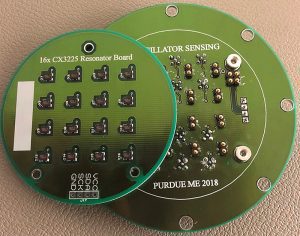
“Climate control and proper ventilation are especially important because most people spend considerably more time indoors than outside,” said Jeff Rhoads, a professor of mechanical engineering in Purdue’s College of Engineering. “Climate control and ventilation are also huge sources of energy consumption in the United States and around the world.”
Rhoads and his team have developed a lower-cost, lower-energy carbon dioxide sensor that could change the way energy is used to heat, cool and ventilate large buildings and eventually homes.
The Purdue project is supported by ARPA-E, the Advanced Research Projects Agency – Energy, a government agency tasked with promoting and funding research and development of advanced energy technologies.
The technology identifies when carbon dioxide is released into the air by a person, or people entering and breathing inside that space.
The Purdue sensor detects the carbon dioxide so that heating and ventilation systems can control the climate and air turnover in spaces that are occupied, instead of using energy to control rooms that are empty.
“We leverage two technologies with our innovative device: resonant sensing and resistive sensing,” said Rhoads, a leading sensor researcher who serves as the director of Purdue’s Ray W. Herrick Labs. “We use them in combination to detect carbon dioxide. This is a great alternative to available technologies that may not reliably measure carbon dioxide while remaining competitive in cost and power consumption.”
Rhoads said the Purdue sensor also helps address privacy concerns about using camera technology for detecting when someone enters and leaves a room.
The team, which includes professors Bryan Boudouris from Purdue’s School of Chemical Engineering, and Jim Braun and George Chiu from Purdue’s School of Mechanical Engineering, is working to integrate the sensor with other Internet of Things building technology.
The team has worked to patent the technology with the Purdue Research Foundation Office of Technology Commercialization. The team is seeking partners. For more information on licensing a Purdue innovation, contact Will Buchanan of the Office of Technology Commercialization at [email protected] and mention track code 2020-RHOA-68738.
About Purdue Research Foundation Office of Technology Commercialization
The Purdue Research Foundation Office of Technology Commercialization operates one of the most comprehensive technology transfer programs among leading research universities in the U.S. Services provided by this office support the economic development initiatives of Purdue University and benefit the university’s academic activities through commercializing, licensing and protecting Purdue intellectual property. The office recently moved into the Convergence Center for Innovation and Collaboration in Discovery Park District, adjacent to the Purdue campus. The office is managed by the Purdue Research Foundation, which received the 2019 Innovation and Economic Prosperity Universities Award for Place from the Association of Public and Land-grant Universities. The Purdue Research Foundation is a private, nonprofit foundation created to advance the mission of Purdue University. Visit the Office of Technology Commercialization for more information.
Writer: Chris Adam, 765-588-3341, [email protected]
Source: Jeff Rhoads, [email protected]
